
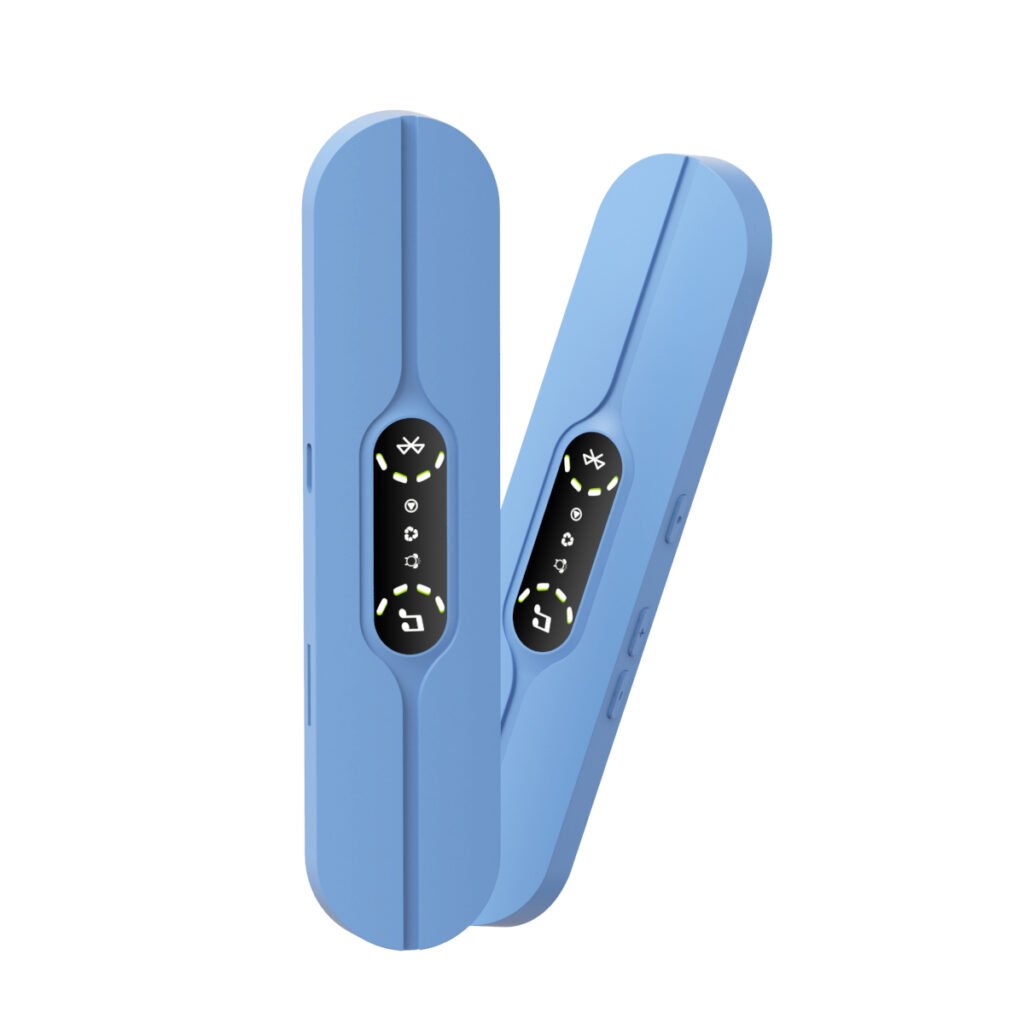
In short, an under pillow speaker is a thin, flat audio device placed beneath a pillow to deliver private sound for sleep, meditation, or tinnitus masking. Unlike headphones or earbuds, it requires nothing on or in the ears, making it ideal for side sleepers and couples with mismatched schedules. For importers and brand owners, it represents one of the most underserved niches in the $29.3 billion sleep tech market: a $106 million category with almost zero dedicated B2B content.
If you’ve been searching for a reliable under pillow speaker manufacturer and found nothing but consumer product reviews, you’re not alone. Most search results point to roundup articles like “Best Pillow Speakers for Sleep.” Helpful for shoppers. But useless for buyers who need MOQs, certification specs, and factory-direct pricing.
Specifically, this guide covers everything a B2B buyer needs: market opportunity and buyer demographics, product types and OEM specifications, customization options, compliance requirements for the US/EU/UK, real cost and margin analysis, and a practical evaluation checklist for choosing the right manufacturer.
Key Takeaways
- The under pillow speaker market is valued at approximately $106M globally (2024), sitting inside a sleep tech market projected to reach $134.7B by 2034 at 18.5% CAGR.
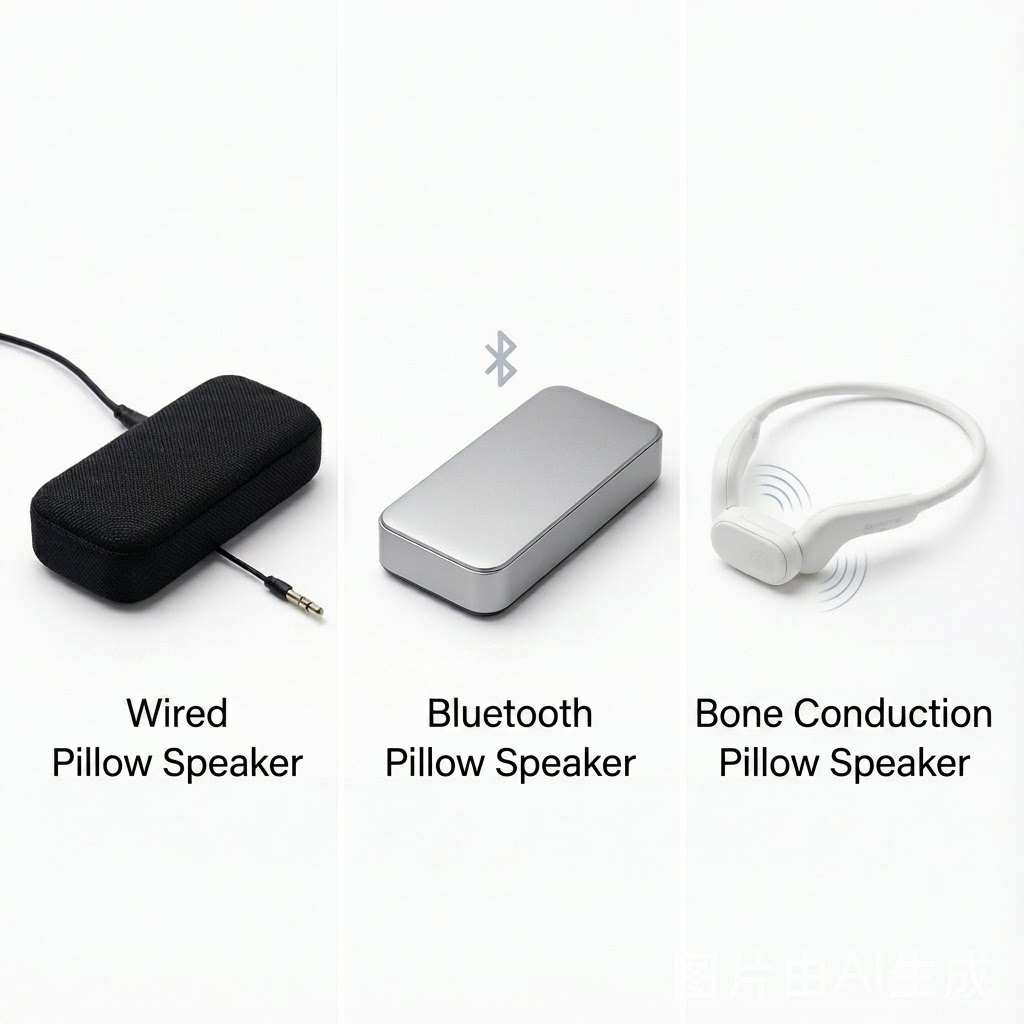
- Three product tiers dominate OEM sourcing: wired ($3 to $8/unit), Bluetooth ($8 to $15/unit), and bone conduction ($15 to $25/unit), with retail prices spanning $30 to $90.
- FCC Part 15 (US), CE + RoHS + REACH (EU), and UKCA (UK) certifications are mandatory. Budget 4 to 12 weeks and $1,500 to $5,000 per market.
- Key OEM differentiators include driver thickness (3mm or less), battery life (8+ hours), USB-C charging, and custom audio profiling for tinnitus, meditation, or white noise use cases.
- Low-MOQ manufacturers (300 units) allow importers to test-market before committing to volume orders, reducing inventory risk significantly.
The $106M Opportunity Nobody’s Talking About
Market Size & Growth Data
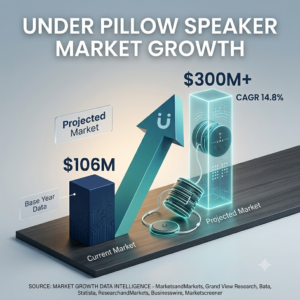
The global sleep tech devices market was valued at $29.3 billion in 2025 and is projected to reach $134.7 billion by 2034, growing at a compound annual growth rate (CAGR) of 18.5% (Global Market Insights, 2025). Within that massive ecosystem, the under pillow speaker segment represents an estimated $106 million. A small but rapidly growing niche.
So why does a $106M market matter to B2B buyers? Because it’s large enough to be profitable and small enough to be ignored by major players. Bose, Sony, and Apple aren’t making pillow speakers. That leaves the category wide open for private-label brands and specialty importers.
In general, the growth drivers are concrete:
- Tinnitus affects roughly 14% of adults globally (JAMA Neurology, 2022), with approximately 50 million Americans experiencing chronic symptoms. Sound therapy, including pillow speakers, is a frontline management tool recommended by audiologists.
- Additionally, shift workers represent 27% of the UK workforce (NHS BME Network, 2025) — roughly 8.7 million people. Many need to sleep during daylight hours and rely on white noise or audio masking.
- Furthermore, bone conduction technology is expanding the addressable market by solving the “partner disturbance” problem that limits traditional speaker adoption.
Consequently, for importers, this means demand is diversified across medical, wellness, and general consumer segments. Not tied to a single trend that could collapse.
Who’s Buying Under Pillow Speakers
Understanding end-users helps you specify the right product for your target channel. Here are the four primary buyer segments:
| Segment | Core Need | Product Preference | Sales Channel Fit |
|---|---|---|---|
| Tinnitus sufferers | Sound masking overnight | Wired or Bluetooth; white noise optimization | Pharmacy, medical supply, Amazon |
| Shift workers | Sleep during daytime; audio masking | Bluetooth with long battery | Big-box retail, direct-to-consumer |
| Couples with mismatched schedules | Private audio without disturbing partner | Bone conduction (ultra-quiet) | Premium retail, gift market |
| Side sleepers & meditation users | Comfortable overnight audio | Ultra-thin wired or BT | Wellness brands, yoga/meditation retailers |
A German gift buyer I’ll call Marcus discovered this segmentation the hard way. He’d ordered 2,000 generic Bluetooth pillow speakers for a pharmacy chain, expecting them to sell as general wellness gadgets. They sat on shelves for three months. Then a pharmacist mentioned that tinnitus patients kept asking specifically for wired models. No charging, no Bluetooth pairing, just plug and play. Marcus repositioned the next batch toward tinnitus-focused marketing with a pharmacy-specific SKU, and sell-through jumped from 12% to 68% in the first quarter. Therefore, the lesson here is clear: product spec and buyer segment must be aligned before you place an OEM order.
Why Retailers Are Adding Pillow Speakers to Their Product Lines
Three reasons retailers are stocking up:
- Low return rates. Unlike sleep headphones and earbuds, which see high returns due to comfort issues with side sleepers, under pillow speakers have no in-ear or on-head component. As a result, the return rate is closer to standard small electronics (3 to 5%) versus sleep headphones (often 12 to 18%).
- High perceived value, low production cost. A pillow speaker retailing at $45 to $60 typically costs $6 to $12 at factory-direct pricing. That means a 4x to 6x markup. Healthy margins for a product that doesn’t require complex consumer education.
- Cross-sell potential. Pillow speakers pair naturally with sleep masks, sunrise alarm clocks, and white noise apps. Retailers can build sleep bundles that increase average order value.
For instance, if you’re already in the sleep tech space, you may also want to explore our bluetooth sleep mask OEM guide to see how these products complement pillow speakers in a portfolio strategy.
Under Pillow Speaker vs. Sleep Headphones vs. Earbuds: A B2B Comparison
Fundamentally, under pillow speakers, sleep headphones, and earbuds serve similar needs — but they differ significantly in comfort, durability, return rates, and margins. Here’s a B2B comparison to help you choose the right product line for your channel:
| Factor | Under Pillow Speaker | Sleep Headphones (Headband) | Sleep Earbuds |
|---|---|---|---|
| Comfort (side sleepers) | Excellent – nothing on head | Good – soft band, but speakers press | Fair – ear pressure buildup |
| Partner disturbance | Low to moderate | Very low | None (in-ear) |
| Durability | High (no moving parts, wired) | Medium (band wear, washing issues) | Low (tiny components, battery degradation) |
| Return rate (estimated) | 3 to 5% | 12 to 18% | 15 to 25% |
| Factory cost range | $3 to $25 | $5 to $18 | $8 to $30 |
| Typical retail price | $30 to $90 | $25 to $60 | $40 to $120 |
| Gross margin (approx.) | 70 to 85% | 65 to 75% | 60 to 70% |
| Best-fit channel | Pharmacy, gift, hotel, medical | DTC e-commerce, Amazon | Premium tech, Apple-adjacent |
The bottom line for B2B buyers: Under pillow speakers offer the best combination of low return rates, high margins, and channel versatility. Sleep headphones win on partner-disturbance isolation but suffer from durability and return issues. By contrast, earbuds have the highest ceiling but the lowest floor. Tiny batteries and delicate components mean warranty claims eat into margins.
Overall, for a new entrant testing the sleep audio category, starting with under pillow speakers is the lowest-risk path. You can always expand into headbands and earbuds later using the same supplier relationships.
Product Types & Specifications: What to Specify with Your Under Pillow Speaker Manufacturer
Traditional Wired Pillow Speakers
To begin with, wired pillow speakers are the original format, and still the best-selling SKU in many markets. They connect via a 3.5mm audio jack to a phone, tablet, or dedicated audio device.
Why they still dominate:
- Zero charging required. No battery to degrade, no USB port to break. A wired pillow speaker can last 5+ years with no maintenance.
- Lowest factory cost. At $3 to $8 per unit (FOB Shenzhen), they offer the highest margin percentage in the category.
- Medical and hospitality fit. Hospitals and hotels prefer wired because there’s no Bluetooth pairing, no battery management, and no Wi-Fi concerns. The Sound Oasis brand built an entire business on hospital-grade wired pillow speakers.
What to specify:
- Cable length: 1.5m minimum (2m preferred for hotel/hospital use)
- Cable type: Braided nylon jacket (avoids tangling, feels premium)
- Driver size: 40mm full-range
- Thickness: 5mm or less for comfort
- Connector: Gold-plated 3.5mm for corrosion resistance
Bluetooth Under Pillow Speakers
On the other hand, Bluetooth models represent the mainstream consumer play. With BT 5.0+ connectivity, built-in rechargeable batteries, and wireless convenience, they command higher retail prices ($40 to $90) and appeal to the largest consumer segment.
What to specify:
- Bluetooth version: 5.0 minimum (5.2+ preferred for lower power consumption and better range)
- Battery capacity: 500 to 1,000mAh (target 8+ hours of playback at moderate volume)
- Charging port: USB-C (mandatory for EU market after 2024 directive)
- Driver configuration: Dual 40mm or single 50mm
- Thickness: 3mm or less for the speaker pad section (anything thicker is uncomfortable for side sleepers)
- Built-in controls: Play/pause, volume, track skip (touch-sensitive or physical buttons)
A note on Bluetooth module selection: Cheaper OEMs may use BT 4.2 modules to save $0.30 to $0.50 per unit. However, this causes pairing issues, short range, and battery drain. Always specify BT 5.0+ and ask which module brand the factory uses. CSR, Realtek, and JL are common. CSR/QCC is the premium tier.
Bone Conduction Pillow Speakers
Finally, bone conduction is the emerging differentiator in the under pillow speaker category. Instead of moving air with a traditional cone driver, bone conduction transducers send sound vibrations through the pillow material and into the skull, bypassing the outer and middle ear entirely.
Why it matters for B2B buyers:
- Near-zero sound bleed. First, because the audio transmits through solid material rather than air, a partner lying inches away hears almost nothing. This solves the #1 complaint about traditional pillow speakers.
- Additionally, for tinnitus applications: Bone conduction delivers audio directly to the inner ear, which audiologists have found effective for tinnitus masking therapy. Particularly for patients who find traditional speakers insufficient.
- Premium positioning. With factory costs of $15 to $25 and retail prices of $60 to $120, bone conduction models command the highest margins and support premium brand positioning.
Of course, the technology is still maturing, which means early movers can establish category leadership before major brands enter. Search volume for “bone conduction pillow speaker” is growing steadily (currently 400 to 600 monthly searches), suggesting consumer awareness is building.
What to specify:
- Transducer type: Piezoelectric or electromagnetic (piezo is quieter but more durable)
- Frequency response: 80Hz to 20kHz (bone conduction naturally cuts off below 100Hz, so don’t expect deep bass)
- Pillow integration: Flat transducer pad vs. built into a pillow insert
- Power: Wired or rechargeable (rechargeable is preferred for premium positioning)
The Specs That Matter Most
When sourcing under pillow speakers from an OEM manufacturer, these six specs are non-negotiable:
| Specification | Target | Why It Matters |
|---|---|---|
| Speaker thickness | 3mm or less | Anything thicker causes neck discomfort. The #1 return reason. |
| Battery life (wireless) | 8+ hours | Needs to last a full night. 10+ hours is ideal for shift workers. |
| Charging port | USB-C | EU mandate + universal compatibility. Micro-USB signals low quality. |
| Frequency response | 80Hz to 20kHz | Covers voice, white noise, and music well enough. |
| IP rating | IPX4 minimum | Sweat and humidity resistance. Critical for overnight use. |
| Material | Breathable fabric cover | Avoid PVC/plastic. Causes sweating and feels cheap. |
OEM Customization Options for Under Pillow Speakers
Generally speaking, working with an under pillow speaker manufacturer opens up a range of customization options that let you differentiate your brand without reinventing the product. As a sleep speaker OEM partner, we see three areas where smart customization creates the most market value:
Form Factor & Materials
- Shape: Rectangular (most common), oval (ergonomic for side sleepers), or round (compact/travel)
- Size: Standard (25x20cm), compact (18x15cm), or extended (30x25cm for king-size pillows)
- Cover material: Cotton, bamboo fabric, velvet, or waterproof PE for hospitality or medical channels
- Color: Full Pantone matching at MOQ 1,000+ units; limited color options below that threshold
Audio Profiles
This is where smart OEMs create real differentiation. The same hardware can be tuned for dramatically different use cases:
- Voice clarity mode: Boosted midrange (1 to 4kHz) for audiobooks, podcasts, and meditation guides. Reduces bass to prevent muddiness through pillow material.
- White noise optimization: Flat frequency response with slight high-frequency emphasis. Ideal for tinnitus masking and sleep onset.
- Music mode: Wider frequency response with moderate bass boost. Best for general consumer market.
For example, ask your manufacturer about DSP (digital signal processing) tuning. This is done in firmware and costs almost nothing per unit but dramatically affects perceived quality.
Custom Branding & Packaging
- Logo: Embroidered (premium feel), screen-printed (cost-effective), or heat-transferred (photographic detail)
- Packaging: Retail box with custom design, magnetic-closure gift box, or eco-friendly kraft box
- Inserts: Quick-start guide, warranty card, branded microfiber pouch
- Hang tags and barcodes: Essential for retail shelf placement
Firmware Features
Firmware customization is an underused lever. Even basic Bluetooth models can include:
- Auto-off timer: 30/60/90-minute sleep timer (the #1 requested feature in consumer reviews)
- EQ presets: Pre-tuned profiles accessible via button combination or companion app
- Sleep mode: Gradual volume decrease over 20 minutes (mimics natural sleep onset)
- Memory function: Resumes playback at last volume level when reconnected
 Want to see what’s possible? Request our OEM catalog to explore sample configurations, material swatches, and pricing across all three product tiers. Explore OEM options →
Certification & Compliance for Major Markets
Under pillow speakers require FCC Part 15 (US), CE + RoHS + REACH (EU), and UKCA (UK) certifications before import. Budget 4 to 12 weeks and $1,500 to $5,000 per market depending on product type. Here’s the detailed breakdown:
US Market: FCC Part 15
All electronic devices sold in the United States must comply with FCC Part 15, which regulates unintentional and intentional radiators. For under pillow speakers:
- Wired models: Fall under FCC SDoC (Supplier’s Declaration of Conformity). Simpler and cheaper. Testing only, no FCC ID filing required.
- Bluetooth models: Require FCC Certification (FCC ID) through a TCB (Telecommunication Certification Body). This involves lab testing for RF emissions, SAR (if applicable), and EMC compliance.
Timeline: 4 to 8 weeks for straightforward BLE products; 8 to 12 weeks for multi-radio or complex configurations.
Cost: $1,500 to $3,500 for SDoC testing; $3,000 to $5,000+ for full FCC ID certification (including lab fees and TCB filing).
EU Market: CE Marking, RoHS, REACH
Not surprisingly, the EU has the most comprehensive requirements:
- CE Marking: Mandatory conformity marking showing compliance with EU directives (RED for Bluetooth, EMC Directive for wired, LVD for electrical safety).
- RoHS: Restricts hazardous substances (lead, mercury, cadmium, etc.) in electronic equipment. All components must be tested.
- REACH: Requires registration and evaluation of chemical substances. Your manufacturer must provide REACH compliance documents for all materials used.
Timeline: 6 to 10 weeks for complete testing and documentation.
Cost: $2,500 to $5,000 depending on product complexity and number of applicable directives.
UK Market: UKCA
Post-Brexit, the UK requires UKCA (UK Conformity Assessed) marking for products sold in the UK market. The technical rules are largely similar to CE, but testing must be done by a UK-Approved Body (not just any EU Notified Body).
Timeline: 4 to 8 weeks (faster if your CE testing lab is also UK-approved).
Cost: $1,000 to $2,500 extra if combined with CE certification; $2,500 to $4,000 standalone.
A Real-World Caution: Don’t Skip Document Checks
A UK-based importer learned this lesson the hard way. He’d sourced 3,000 Bluetooth pillow speakers from a factory that promised “CE compliant” but couldn’t produce actual test reports. When HMRC (UK Customs) inspected the shipment at Felixstowe, the lack of valid UKCA paperwork triggered a hold. The containers sat in a bonded warehouse for six weeks while he scrambled to arrange retroactive testing. Testing fees: £4,200. Warehousing charges: £3,800. And he missed the pre-Christmas selling window entirely.
In short: Always request actual certification documents, not verbal promises, before placing an order.
Pro tip: Choose an under pillow speaker manufacturer that already holds CE, FCC, and UKCA certifications for their base models. You’ll only need to re-test for your custom branding or firmware changes, cutting both timeline and cost by 40 to 60%.
Pricing & Margins: What Importers Actually Make
Now, let’s get into the numbers that matter to your P&L.
Factory-Direct Price Benchmarks
Under pillow speaker wholesale pricing varies significantly by product type and order volume. These are approximate FOB (Shenzhen) prices based on current market conditions:
| Product Type | MOQ 300 | MOQ 1,000 | MOQ 5,000 |
|---|---|---|---|
| Wired pillow speaker | $5 to $8 | $4 to $6 | $3 to $4.50 |
| Bluetooth pillow speaker (BT 5.0) | $12 to $15 | $10 to $13 | $8 to $11 |
| Bone conduction pillow speaker | $20 to $25 | $17 to $22 | $15 to $19 |
Prices include basic OEM branding (logo printing) but exclude custom packaging, premium materials, and certification costs.
Typical Retail Price Points
| Product Type | Budget Retail | Mid-Market Retail | Premium Retail |
|---|---|---|---|
| Wired | $20 to $30 | $35 to $50 | $55 to $70 |
| Bluetooth | $35 to $50 | $50 to $70 | $75 to $90 |
| Bone conduction | $60 to $80 | $80 to $100 | $100 to $130 |
Margin Breakdown: A Realistic Example
For example, let’s walk through a realistic scenario. Say you’re importing Bluetooth under pillow speakers at MOQ 1,000:
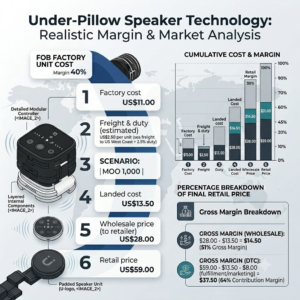
- Unit cost (FOB): $11.00
- Freight & duty (estimated): $2.50 per unit (sea freight to US West Coast + 2.5% duty)
- Landed cost: $13.50
- Wholesale price (to retailer): $28.00
- Retail price: $59.00
Your gross margin (wholesale): $28.00 – $13.50 = $14.50 per unit. That’s a 51% gross margin.
Alternatively, if selling DTC (direct-to-consumer) at $59.00: Your gross margin (DTC): $59.00 – $13.50 – $8.00 (fulfillment/marketing) = $37.50 per unit. That’s a 64% contribution margin.
That’s a healthy business. Moreover, because return rates are low (3 to 5%), your net margin holds up better than categories with high return overhead.
How MOQ Affects Your Unit Cost
The price curve between MOQ 300 and MOQ 5,000 is steep. Often 30 to 40% savings. But here’s the key question: do you really need 5,000 units on your first order?
For a new product launch, I recommend starting at the minimum viable MOQ (300 to 500 units) to test the market. Yes, your unit cost is higher. But you avoid the far more expensive mistake of sitting on 5,000 units that don’t sell. Once you have 60 to 90 days of sales data, reorder at 1,000 to 2,000 units to capture the price break.
From Small Order to Big Success: A Case Study
An Amazon seller I’ll call Jenna followed exactly this path. She launched a Bluetooth pillow speaker at MOQ 500, priced at $49, and sold through in 7 weeks. Her second order was 2,000 units at a 23% lower unit cost, which let her run a $5 promotion and still maintain margin. By the third order (5,000 units), she’d captured enough reviews to rank on page one for “pillow speaker bluetooth.” And her unit economics were dialed in. Clearly, the key was treating the first order as market research, not a volume play.
5 Questions to Ask Before Choosing Your Under Pillow Speaker Manufacturer
Not all factories operate at the same standard. Here’s a due diligence checklist that separates serious OEM partners from trading companies posing as manufacturers:
1. “Do you manufacture in-house, or do you source from another factory?”
Why ask: Many “manufacturers” on Alibaba and Made-in-China are actually trading companies that mark up another factory’s product. They can’t control quality, lead times, or customization depth. Ask for factory photos, business license, and if possible, a video call showing the production floor.
2. “What certifications do your current products hold?”
Why ask: If the factory has never produced a CE- or FCC-certified product, they won’t understand the documentation requirements, and your certification process will be painful. On the other hand, a manufacturer with existing FCC ID and CE certificates can leverage that test data, saving you weeks and thousands of dollars.
3. “What is your sample lead time, and what does sampling cost?”
Why ask: A manufacturer that takes 3 weeks to produce a sample will take 8 weeks to produce a bulk order. Look for 7 to 10 day sampling. Sample cost should be $50 to $150 per unit (often refundable against your first order). If they refuse to send samples, walk away.
4. “Can you provide reference contacts from buyers in my market?”
Why ask: A factory with satisfied US, UK, or EU clients has already navigated the compliance and logistics challenges you’ll face. If, however, they can’t provide references, they either have no export experience to your region or have unhappy customers. Both are red flags.
5. “What is your defect rate, and what is your warranty policy?”
Why ask: Industry-standard defect rates for small electronics are 1 to 3%. Anything higher signals quality control issues. The manufacturer should offer a 1-year warranty and be willing to discuss RMA (return merchandise authorization) procedures before you place an order.
Why Leach Trading
Leach Trading is a Shenzhen-based OEM/ODM manufacturer specializing in sleep audio products. We produce the full range of under pillow speakers: wired, Bluetooth, and bone conduction, all under one roof. CE, FCC, and UKCA certifications are already in place across our core product line.
Our MOQ starts at 300 units, making us accessible to brands testing the market without committing to volume orders. Sampling takes 7 to 10 days, and our engineering team supports full customization: form factor, audio profiling, firmware features, branding, and packaging.
Besides pillow speakers, we also manufacture Bluetooth sleep masks and sunrise alarm clocks. That gives you the option to build a multi-product sleep brand from a single supplier. Fewer vendors, fewer quality variables, simpler logistics.
If you’re ready to source from an under pillow speaker manufacturer that understands B2B requirements, we’d like to start with a conversation. Get a free sample to evaluate quality before committing to a large order. →
FAQ: Under Pillow Speaker OEM Sourcing
What is an under pillow speaker?
An under pillow speaker is a thin, flat audio device placed beneath a pillow to deliver private sound for sleep, meditation, or tinnitus masking, without wearing headphones or earbuds. It connects via a 3.5mm audio cable (wired models) or Bluetooth (wireless models).
What is the minimum order quantity (MOQ) for OEM under pillow speakers?
MOQ varies by manufacturer and product type. At Leach Trading, your under pillow speaker manufacturer, MOQ starts at 300 units for most models. Higher MOQs (1,000 to 5,000 units) unlock lower per-unit pricing through economies of scale in part sourcing and production efficiency.
What certifications do under pillow speakers need for the US market?
For the US market, wired under pillow speakers require FCC SDoC (Supplier’s Declaration of Conformity), while Bluetooth models require full FCC Certification (FCC ID) under Part 15. Testing takes 4 to 8 weeks and costs $1,500 to $5,000 depending on product complexity.
How much does it cost to manufacture an under pillow speaker?
Factory-direct (FOB Shenzhen) prices range from $3 to $8 for wired models, $8 to $15 for Bluetooth models, and $15 to $25 for bone conduction models, depending on MOQ and customization level. Retail prices typically range from $30 to $90, offering 50 to 85% gross margins.
What is bone conduction technology in pillow speakers?
Bone conduction pillow speakers use piezoelectric or electromagnetic transducers to send sound vibrations through the pillow and skull bones, skipping the outer and middle ear entirely. This delivers clear audio to the listener with almost zero sound bleed, making it ideal for couples and tinnitus sufferers.
How long does OEM production take for under pillow speakers?
From approved sample to bulk shipment, production takes roughly 25 to 35 days for MOQ 300 to 1,000 units. Add 7 to 10 days for sampling and 4 to 12 weeks for certification (if not already held by the manufacturer). Total time from first contact to delivered product: 8 to 14 weeks.