
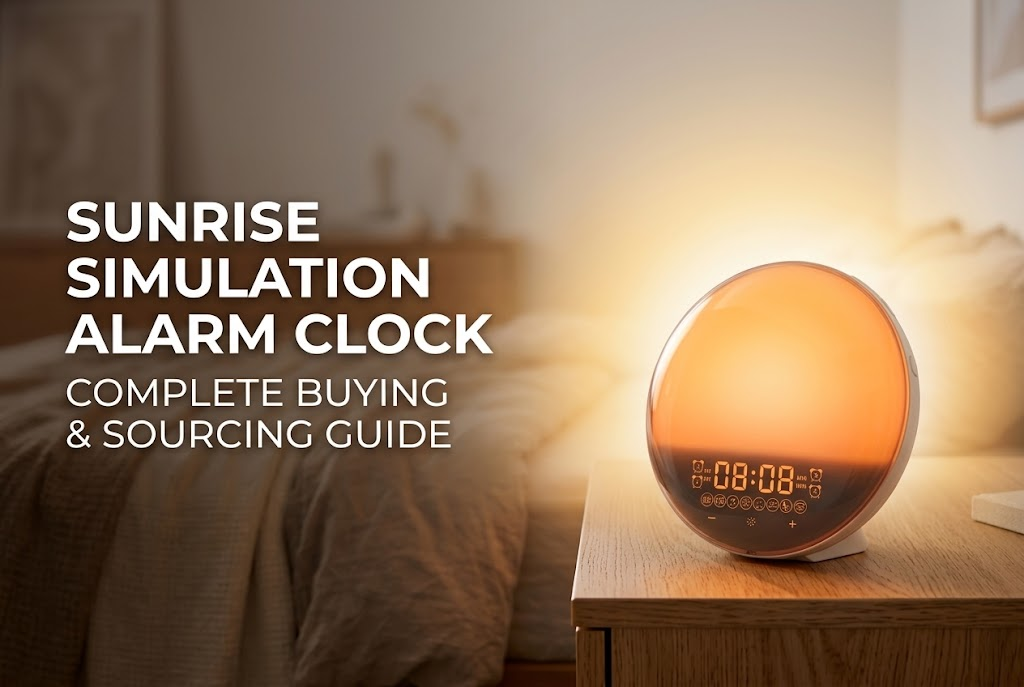
A sunrise simulation alarm clock wakes you up with gradually brightening light instead of a jarring sound. People search for this product under a lot of different names. Some call it a sunrise simulator. Others call it a dawn simulator clock or a daylight simulator alarm clock. Some just call it a sunrise alarm clock wake up light. They’re all describing the same core idea. This guide covers how it works and the main types on the market. It also covers the technical specs that actually matter, plus what to check if you’re sourcing one from a supplier.
What Is a Sunrise Simulation Alarm Clock?
At its core, this device is a bedside light paired with an alarm function. Instead of triggering full brightness instantly, it increases light output gradually over a set window before your wake time. The goal is to mimic a natural sunrise. Your body starts transitioning out of sleep before the alarm sound even plays.
How Does a Sunrise Simulator Actually Work?
The Light Curve
Most units ramp from near-darkness to full brightness over 15 to 30 minutes, though some allow up to 60. The light typically shifts from a warm amber tone early in the cycle. It moves to a brighter white light closer to wake time. This gradual shift is the entire mechanism. There’s no complex technology behind it beyond a dimmable LED and a timer.
Sound Layer
Most models add a sound element once the light reaches full brightness, or a few minutes before. This can be a traditional alarm tone, nature sounds, or FM radio. A smart sunrise alarm clock often lets you customize this layer through a companion app.
Types of Sunrise Simulation Alarm Clocks
Basic Dawn Simulator Clocks
These offer a fixed or lightly adjustable light curve, a small number of alarm sounds, and simple button controls. They’re the most affordable entry point into the category. Most are built around a single LED module and a mechanical or basic digital timer.
Smart Sunrise Alarm Clocks (App-Connected)
These connect to a phone app for schedule automation, custom light curves, and sometimes integration with smart home systems. A smart sunrise and sunset simulation alarm clock in this category often supports two sequences in one device. It handles a morning wake-up and an evening wind-down.
Sunrise Alarm Clocks With Built-In Sound Machine
These combine the light function with a dedicated white noise or nature-sound speaker. They’re aimed at buyers who want both a wake-up tool and a sleep-aid device in a single unit. Our white noise machine collection includes several models built around this combined approach.
Technical Specifications That Actually Matter
Marketing copy tends to focus on the “gentle wake-up” story. The numbers behind that story are what separate a well-built unit from a weak one. Check these specs before comparing price:
- Peak brightness: look for at least 300 lux at typical bedside distance — budget units often sit well below this without stating it clearly
- Color temperature range: a genuine sunrise effect needs a shift from roughly 2000K (warm amber) to 6500K (daylight white). A single fixed color that just dims doesn’t count
- Light curve duration options: at minimum 10, 20, and 30-minute presets; premium units offer stepless adjustment up to 60 minutes
- Speaker output: 2W to 3W is typical for the built-in alarm speaker. Models with an integrated sound machine often run higher for fuller white noise playback
- Backup power: a capacitor or small battery that holds the time and schedule through a brief power loss. This keeps a blackout from resetting your wake time
- Connectivity: Bluetooth 5.0 or higher for app-connected models, since older versions drain battery faster and drop connection more easily
Sunrise Simulation vs. Traditional Alarm Clocks: What’s the Real Difference?
A traditional alarm clock relies entirely on sound to interrupt sleep. That can trigger a sudden stress response, since your body has no warning before the noise hits. A sunrise simulation alarm clock spreads that transition out instead. Light exposure works with your body’s internal clock rather than against it. The National Institute of General Medical Sciences explains that light is one of the primary signals your circadian rhythm uses. It regulates wake and sleep timing — exactly the mechanism this product is built around.
What to Look for When Choosing One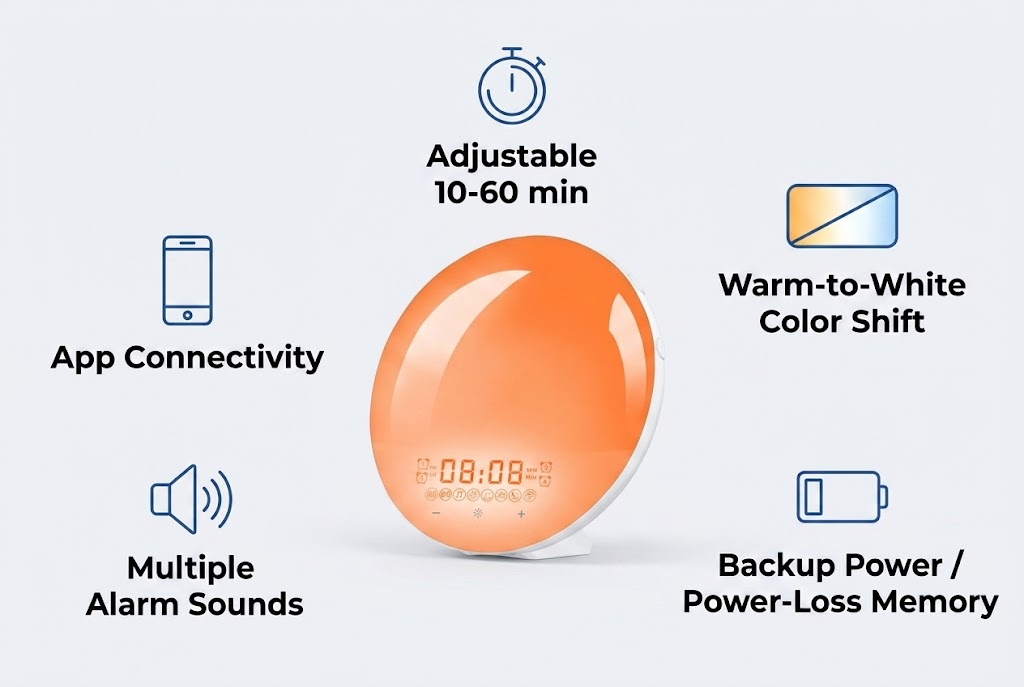
- Adjustable light duration, ideally with at least a 10 to 60 minute range to fit different routines
- Warm-to-white color transition, not a single static color that just gets brighter
- Backup battery or power-loss memory, so a brief outage doesn’t reset your schedule
- Multiple alarm sound options, since a single repetitive tone gets old fast
- App connectivity, if you want to automate different wake times across the week
If you’re comparing full specs across price points, check our wake-up light and sunrise alarm clock market guide. It breaks the category down by tier.
For B2B Buyers: Evaluating a Sunrise Simulation Alarm Clock Supplier
If you’re sourcing this product for private label or wholesale rather than buying a single unit, the evaluation criteria shift. Product specs still matter, but supplier reliability becomes the bigger risk factor.
Manufacturing Track Record
Prioritize manufacturers with proven experience in lighting or sleep-tech electronics specifically. Avoid a general electronics factory adding this as a side product. Five or more years in business is a reasonable baseline for stability. A supplier’s repeat order rate is often a better reliability signal than their marketing materials.
Certifications to Request
Ask for CE, FCC, and RoHS documentation for the exact SKU and color variant you plan to order. A generic certificate covering a different model isn’t enough. Our wholesale and OEM sourcing guide covers the full compliance checklist and typical MOQ tiers for this category.
Sample and Lead Time Expectations
A logo-only order on an existing mold typically ships samples within 1 to 2 weeks. A fully custom light curve, housing color, or app branding usually takes 4 to 6 weeks. That’s how long it takes to get a production-ready sample confirmed. Buyers who skip the sample stage to save time often end up reordering. They discover a color-temperature or brightness issue only after the full production run.
Common Questions People Search When Comparing Models
A lot of buyers land on slightly different phrasings of the same question. Maybe you’re searching for a sunlight simulator alarm clock. Maybe it’s a sunrise simulating alarm clock, or just a dawn simulator. The evaluation criteria above apply the same way, regardless of which term you used to search. Browse current models in our sunrise alarm clock collection to compare them side by side.
Frequently Asked Questions
Does a sunrise simulation alarm clock actually wake you up gently?
Most users report an easier wake experience compared to a sound-only alarm, though results vary by person. The light exposure works best when paired with a consistent wake time, since your body adapts to the pattern over several days.
What’s the difference between a sunrise simulator and a regular smart lamp on a timer?
A dedicated sunrise simulator is built specifically for the gradual light curve and alarm integration, with presets tuned for waking. A generic smart lamp usually requires more manual setup to replicate the same effect.
Can I use a sunrise simulation alarm clock without the sound function?
Yes. Most models let you disable the sound and rely on light alone, or set the sound to a very low volume as a secondary cue.
What MOQ is typical for a private-label sunrise simulation alarm clock?
MOQ depends heavily on customization level. A logo-only order on an existing housing generally requires a smaller batch than a fully custom mold or app-branded firmware. Ask your supplier for tiered pricing so you can compare options before committing to a full production run.