
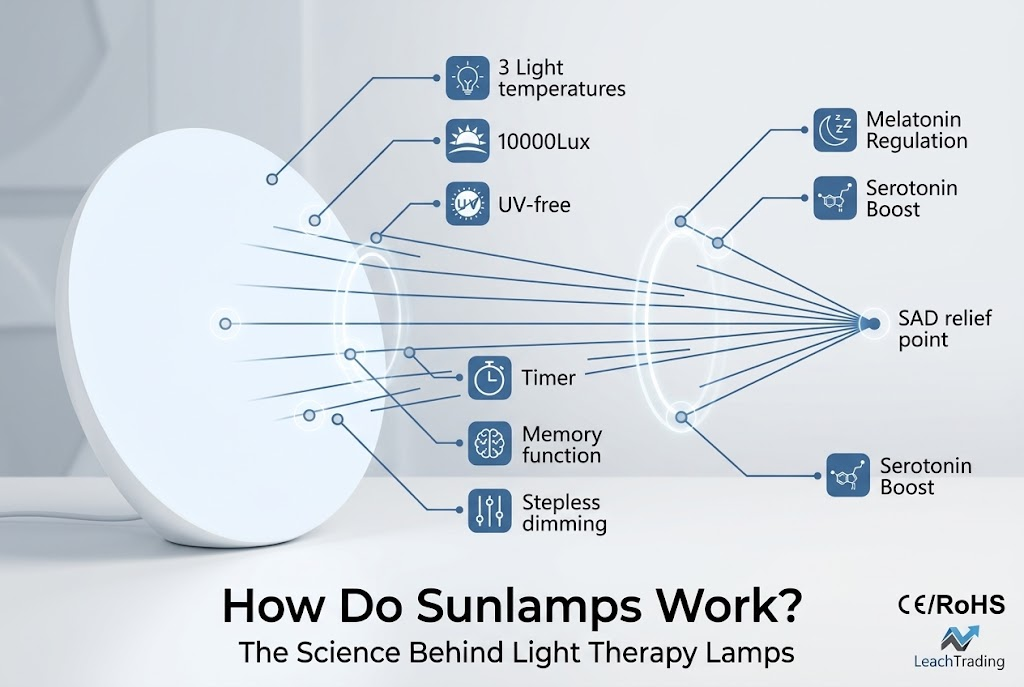
The Basic Mechanism: More Than Just “Bright Light”
A light therapy lamp works by delivering a controlled dose of bright light to your eyes on a consistent schedule. The brightness matters. So does the wavelength range, the distance you sit from it, and the timing of when you use it. All four factors work together. Getting one right while ignoring the others won’t deliver the full effect.
What Happens in Your Eye When You Use a Sunlamp
Your eyes do two separate jobs. One job is ordinary vision, handled by rods and cones. The other job is almost entirely invisible to you, and it’s the one that matters for light therapy.
A small group of cells in your retina contain a light-sensitive pigment called melanopsin. They make up roughly 1 to 2 percent of your retinal ganglion cells. Researchers call these cells intrinsically photosensitive retinal ganglion cells, or ipRGCs. According to research published through the National Institutes of Health, this separate pathway feeds directly into your circadian system. It bypasses your visual system entirely. That’s the actual mechanism behind why light therapy can influence mood and sleep timing, distinct from simply seeing something bright.
Inside the Lamp: What’s Actually Generating the Light
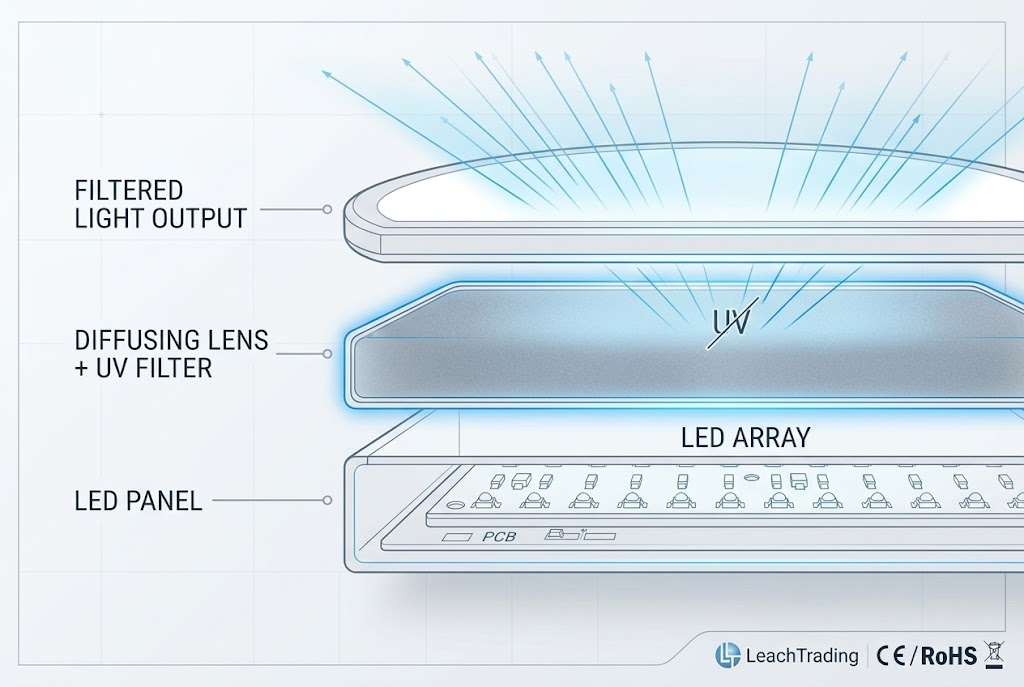
LED Panels vs. Fluorescent Tubes
Older light therapy boxes used fluorescent tubes behind a diffusing panel. Most modern units use LED arrays instead. LEDs run cooler, last longer, and allow more precise control over brightness and color temperature than older fluorescent designs.
The Diffusing Lens and UV Filter
A plastic diffusing lens sits between the light source and your eyes. It spreads the light evenly across the panel instead of leaving visible hot spots. That same lens typically filters out ultraviolet wavelengths. UV doesn’t contribute to the therapeutic effect and carries its own risks. Our winter depression light therapy guide covers this UV filtering point in more depth, since it’s widely misunderstood.
Why Lux, Distance, and Duration All Matter Together
A lamp’s brightness rating only means something at a specific distance. Move twice as far away, and the effective brightness reaching your eyes drops sharply, not gradually. This is why two people using the same lamp at different distances can have very different experiences. Our guide to using a SAD lamp effectively covers the specific distance and timing recommendations. Those recommendations make the biggest practical difference.
How a Sunlamp Differs From Natural Sunlight
Natural sunlight is far brighter than even a strong therapy lamp, often exceeding 50,000 lux outdoors on a clear day. A therapy lamp doesn’t try to replicate that intensity. Instead, it delivers a consistent, controlled dose at close range, filtered to remove UV. That combination makes it usable indoors year-round, regardless of weather or season.
Common Misconceptions About How Sunlamps Work
- “More lux is always better”: past a certain threshold, more brightness doesn’t add meaningful benefit and just increases glare
- “Any bright light works the same way”: a lamp not designed for this purpose may lack proper diffusion or UV filtering
- “You need direct eye contact with the light”: staring directly at the lamp isn’t necessary or recommended. The light reaches the relevant cells through normal peripheral exposure
Maybe you’re comparing specific product options. Our best light therapy lamps guide breaks down the features that actually separate a strong lamp from a weak one.
Frequently Asked Questions
Do sunlamps work through closed eyelids?
Some light does pass through closed eyelids, but at significantly reduced intensity. Most guidance recommends keeping your eyes open. Position the light off to the side rather than staring directly at it.
Why do some people respond to light therapy faster than others?
Individual sensitivity to light varies, along with factors like consistency of use, timing, and distance from the lamp. Some people notice a difference within days, while others take closer to two weeks of consistent use.
Does the color of the light matter, or just the brightness?
Brightness is the primary factor, but wavelength plays a role too. Most therapy lamps use a cool white light. That differs from the warm amber tones found in standard room lighting or wake-up lights.