
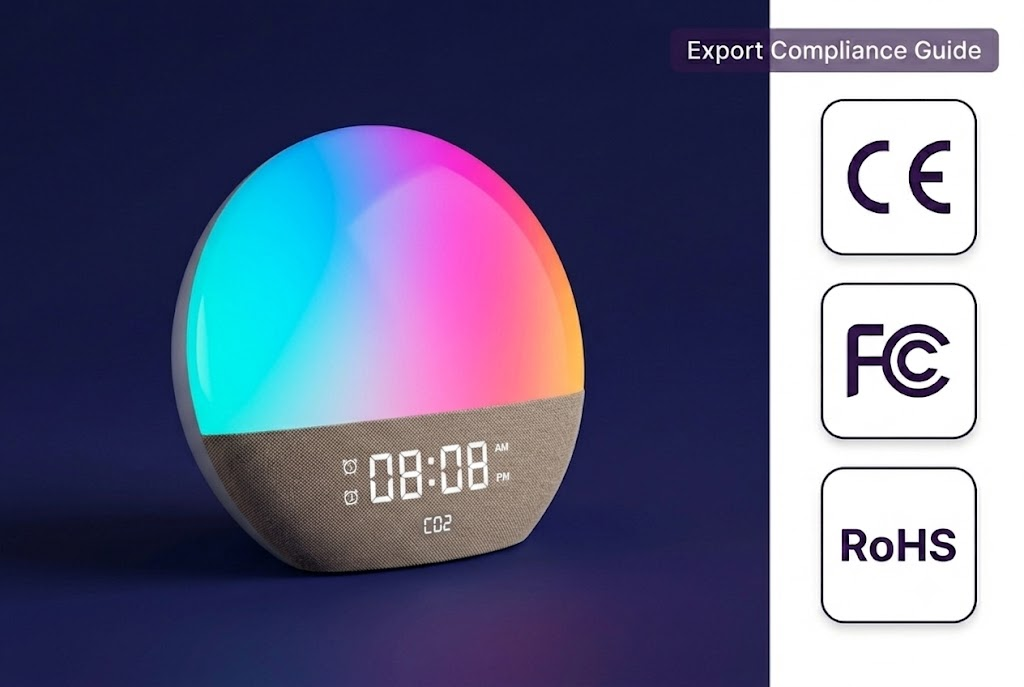
For importers, distributors and private-label brands, sourcing a wake-up light or SAD lamp is not only a product decision — it is a compliance decision. A single missing certification can hold a shipment at customs, trigger a product recall, or block a listing on Amazon EU/US. This guide breaks down exactly what wake-up light export compliance requires, so your sourcing team can vet suppliers with confidence.
Why Export Compliance Matters for Wake-Up Lights & SAD Lamps
Wake-up lights and SAD lamps (Seasonal Affective Disorder lamps) are electrical lighting devices, which means they fall under stricter regulatory scrutiny than passive accessories. Before placing a bulk order, B2B buyers should confirm three categories of compliance: electrical safety, electromagnetic compatibility, and hazardous-substance restriction.
CE Marking (European Union)
Any wake-up light or light-therapy lamp sold in the EU/EEA market must carry the CE mark, confirming conformity with the EU’s Low Voltage Directive and EMC Directive. Buyers should always request the supplier’s Declaration of Conformity (DoC) and test reports, not just a printed logo on the box. For the official scope and legal basis of CE marking, see the European Commission’s official CE marking guidance.
FCC Certification (United States)
Devices with Bluetooth, wireless charging, or radio components (common in modern wake-up lights that pair with an app or speaker) require FCC certification before entering the US market. Always ask for the supplier’s FCC ID and verify it against the FCC’s public equipment authorization database.
RoHS Compliance
RoHS restricts hazardous substances such as lead, mercury and cadmium in electronic components. This matters most for the LED module and internal wiring of a wake-up light — request the RoHS test report specifically for the finished product, not just the raw LED chip.
B2B Sourcing Checklist: What to Ask a Wake-Up Light Supplier
- Certification documents: CE, FCC, RoHS, and (for markets like Japan) PSE test reports for the exact SKU and color variant you plan to order
- Factory audit history: BSCI, ISO 9001, or a recent third-party factory inspection report
- Sunrise/sunset simulation range: adjustable duration (typically 10–60 minutes) and brightness curve accuracy
- Light output for SAD lamp use cases: lux rating at a defined distance, since light-therapy claims depend on it
- OEM/private label flexibility: logo printing, packaging customization, and minimum order quantity (MOQ)
- Warranty and after-sales support for the target region’s consumer protection requirements
Wake-Up Light vs. SAD Lamp: Positioning for Your Market
Although related, the two categories target different buyer intent. A wake-up light is typically marketed for gentle waking and sleep-cycle support, while a SAD lamp is positioned around light therapy for seasonal mood dips, often with a higher lux output. Distributors selling into wellness or pharmacy channels tend to favor the SAD lamp angle, while consumer electronics and home-goods retailers lean toward the wake-up light framing. Leach Trading’s wake-up light collection supports both configurations from the same production line, which simplifies MOQ planning if you want to test both positionings.
How Leach Trading Ensures Compliant Wake-Up Lights & SAD Lamps
Our Shenzhen factory has manufactured wake-up lights and light-therapy devices for over six years, with every production batch tested against CE, RoHS, FCC and PSE standards before shipment. We support OEM and private-label customization, including adjustable sunrise/sunset timing, wake sound libraries, and FM radio integration, so distributors can differentiate their SKU without starting a build from scratch.
If your product line also includes bedtime accessories, pair a wake-up light bundle with our sleep mask and sleep headphone range — a common cross-sell for sleep-wellness retailers building a full night-to-morning routine.
Frequently Asked Questions
Do wake-up lights need FCC certification if they don’t use Bluetooth?
If the unit has no wireless radio component and only functions as a light and alarm, FCC certification requirements are typically lighter, though basic FCC Part 15 verification for electronic emissions may still apply. Always confirm with your supplier’s compliance documentation rather than assuming.
What lux level qualifies a lamp as a “SAD lamp” for light therapy claims?
Most light-therapy guidance references 10,000 lux at a short distance (around 30–50 cm) for effective use, though buyers making therapeutic claims should verify labeling requirements in their target market before finalizing packaging copy.
How long does CE and RoHS testing typically take for a new SKU?
For an established production line, testing and documentation for an existing model with a new color or minor spec change usually takes 1–3 weeks; a fully new design can take 4–8 weeks depending on the testing lab’s queue.