
Quick answer: The evidence is mixed. Evening light can delay sleepiness, and orange or red lenses filter more blue light than clear ones. But large reviews find inconsistent sleep results. Start with less evening screen time and dimmer lights. If you try glasses, wear orange or red lenses indoors for two to three hours before bed. Never wear them to drive.
This article is for general information only. It is not medical advice. If you have ongoing sleep problems, talk to a healthcare provider.
How Evening Light Affects Your Sleep
Light is the main signal for your body clock. Bright light in the evening can slow the release of melatonin, the hormone that helps you feel sleepy. Blue-rich light from screens and LED bulbs has the strongest effect. The American Academy of Ophthalmology says too much screen light in the evening can disrupt your natural sleep cycle. Our guide on how sunlamps work explains how your eyes send these light signals to your body clock.
Do Blue Light Glasses Help You Sleep? What Studies Show
Here is a fair summary of the evidence.
- Sleep: a few small trials found benefits from tinted lenses worn in the evening. A systematic review of crossover trials describes the evidence as inconsistent, because samples are small and methods vary
- Eye strain: studies suggest the glasses do not reduce digital eye strain
- Eye damage: there is no proof that screen light harms your eyes
The American Academy of Ophthalmology does not recommend special blue light glasses for general use. It advises cutting evening screen time and using night mode first. Treat glasses as an optional extra, not a fix.
Red, Orange and Yellow Lenses: Which Is Best for Sleep?
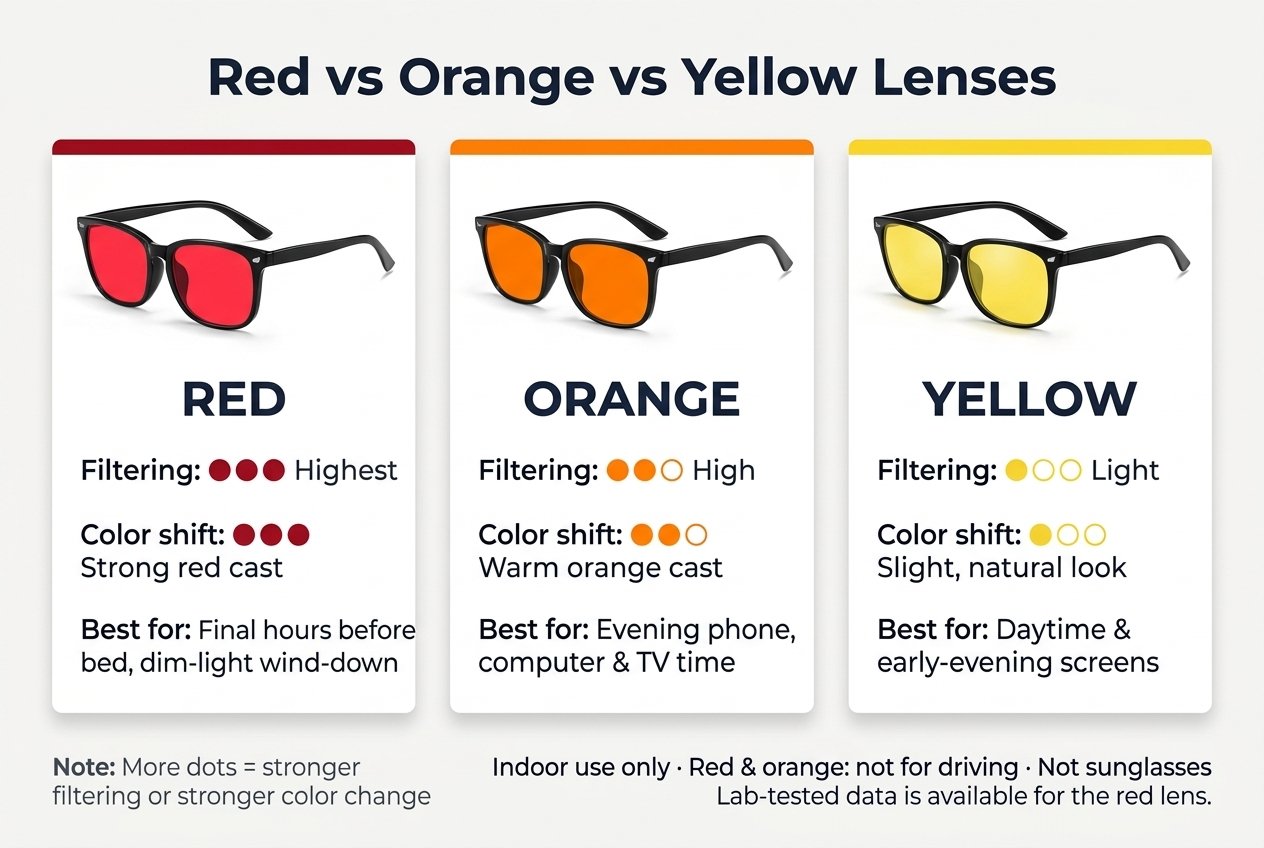
| Lens | Filtering | Color shift | Best for |
|---|---|---|---|
| Red | Highest | Strong red cast | Final hours before bed, dim-light wind-down |
| Orange | High | Warm yellow-orange cast | Evening phone, computer, and TV time |
| Yellow | Light | Slight, looks natural | Daytime and early-evening screens |
Deeper, warmer tints filter more light but change colors more. Lighter tints look natural but filter less. Pick the tint that matches how you’ll use it.
Red Lenses
Red lenses give the strongest filtering. They suit the last hours before bed in a dim room. Colors look very red, so they are not for tasks that need accurate color.
Orange Lenses
Orange lenses are the balanced choice. They filter strongly but keep a more natural view. Many people choose orange for evening screen time.
Yellow Lenses
Yellow lenses are the lightest tint. They are mainly for daytime and early-evening screens, not the main pre-bed choice.
What a Lens Test Report Actually Tells You
A lens color alone doesn’t prove how much light it filters. A spectrophotometer test does. We measured our red lens. Only 0.67% of blue light between 380 and 500 nm passed through. Transmittance stayed below 1% at every measured point from 410 to 560 nm. Light began to pass above roughly 580 nm. You can see the full table on our red, orange and yellow lens blue light glasses page.
Keep one point in mind. This test measures the lens, not your sleep. It shows how much light a lens filters. It does not prove a sleep benefit.
How to Wear Sleep Glasses Safely and Effectively
- Start two to three hours before bed. Evening light builds up slowly, so a short wear time does little
- Dim the room lights too. Bright overhead light still reaches your eyes around the lens
- Use them indoors only. They are not sunglasses and give no UV protection
- Never wear them while driving. Red and orange lenses change color perception, including signal lights
- Keep a steady routine. A nightly habit helps your body expect sleep
Square or Round Frame? Choosing a Style
Comfort decides whether you’ll actually wear them. Two styles of blue light glasses for sleep are available from our range.
- Square frame (model 19220): a 23 g PC frame with 54 mm lenses. It comes with red, orange, or yellow lenses. See the square-frame sleep glasses
- Round frame (model 179): a 25.5 g TR90 frame with 48 mm lenses. It comes with red or orange lenses in a black or clear frame. See the round-frame sleep glasses
Browse the full blue light glasses and sleep glasses collection to compare styles.
What Matters More Than the Glasses
Habits do more than any accessory. Keep a steady bedtime. Put screens away an hour before bed. Use night mode. Keep the bedroom dark and quiet. Our guide to improving sleep quality naturally covers these habits in depth. Our explainer on the healthy sleep cycle shows why a steady routine matters.
Build a Complete Wind-Down Routine
Blue light glasses for sleep work best as one part of a routine. Add a sleep mask or sleep headphones for a dark, quiet night. Try calming audio, and read our guide to calming music for anxiety and sleep. Add a wake-up light or sunrise alarm clock for a gentler morning.
For Retailers and Brands
If you sell sleep products, blue light glasses for sleep are a light, easy-to-ship addition. They pair naturally with masks and alarm clocks. Honest marketing matters because the science is mixed. Our private label blue light glasses buyer’s guide covers lens options, testing, and safe claims. To discuss a custom order, contact our team.
Frequently Asked Questions
Do blue light glasses help you fall asleep faster?
Some small studies suggest evening use of tinted lenses may help. Larger reviews find the results inconsistent. Cutting evening screen time is a safer first step.
Which lens color is best for sleep?
Red and orange lenses filter the most blue light, so they suit the evening. Red filters the most but shifts colors strongly. Orange is more balanced. Yellow filters least and is mainly for daytime screens.
How long before bed should I wear them?
Most routines start two to three hours before bed, in a dimly lit room. Light exposure builds up over hours, not minutes.
Can I wear blue light glasses while driving?
No. Red and orange lenses change color perception and reduce the visibility of some signal lights. Use them indoors only. They are not sunglasses.
Are blue light glasses a medical product?
No. Sleep glasses are consumer wellness eyewear. They are not a medical device or a treatment for any sleep or health condition.